

Suela's Teardrop | Cursed Island of Rossien
- Area: 88.8 sq. km
- Alternate Names: The Teardrop
- Capital: Kajtero
- Number of Towns: 7
- Traditional Office: Warden of Rossien
- Current Ruling House: House Kaj
Suela’s Teardrop is the smallest of the five domains of Rossien and is widely regarded as the kingdom’s most feared, most superstitious, and most politically isolated island. It is known throughout Rossien as the Cursed Island, a reputation shaped by pirate legend, penal history, rumors of haunting, and the presence of Krimia Keep, the largest and most dreaded prison complex in the kingdom.
Although small in area, Suela’s Teardrop occupies an outsized place in Rossieno imagination. It is a place of exile, punishment, folklore, whispered family shame, and old maritime superstition. At the same time, it remains a functioning domain with ports, villages, fisheries, estates, working families, and one of the most specialized governing roles in Rossien.
The domain is ruled by the Kaj line, whose Tidelord traditionally bears the additional identity of Warden, reflecting Suela’s historic responsibility for receiving, containing, and governing prisoners sent from across Rossien. Unlike the other principal domains of Rossien, Suela’s Teardrop has no airport and is accessible only by sea.
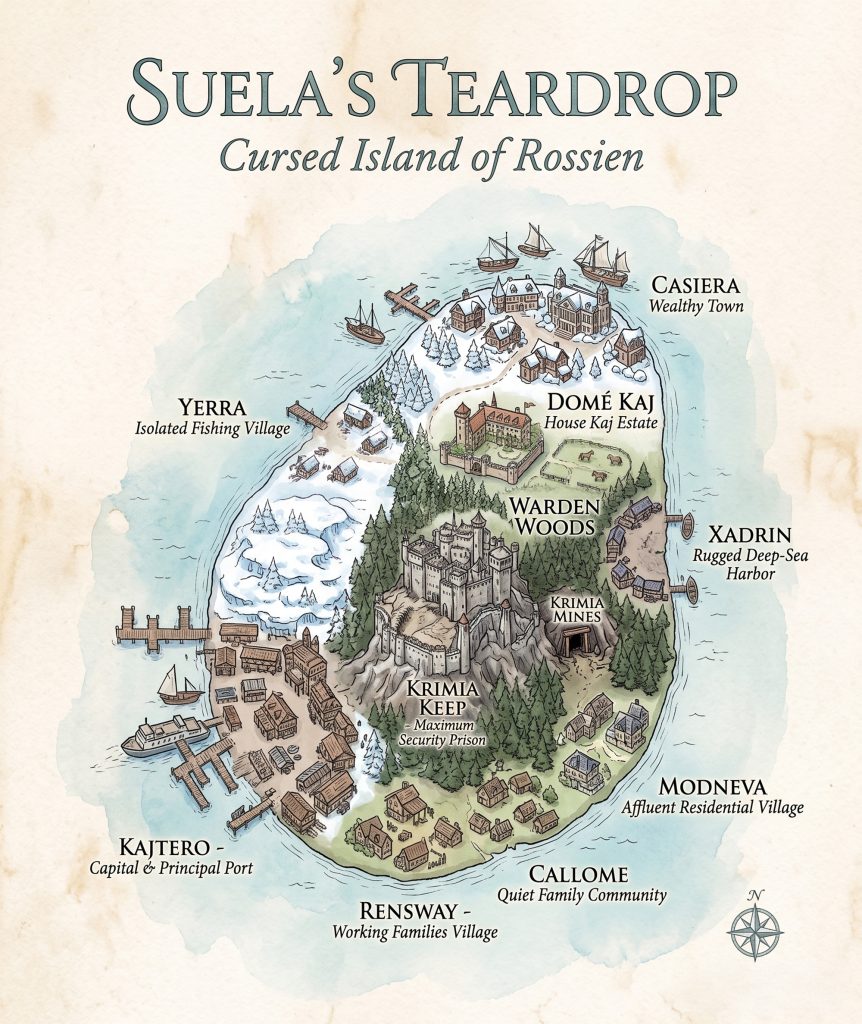
Map of Suela’s Teardrop and its subdomains
The Legend of Suela
Suela’s Teardrop derives its name from one of Rossien’s best-known pirate legends.
According to tradition, Suela was a mermaid who defied the Almighty by seducing a married man and falling in love with him. Her love distorted his vision until he could no longer distinguish truth from illusion. His eye was said to have been shattered, not literally torn apart, but spiritually and mentally broken by the false love he chose over his household.
Driven mad, he perished at sea. Suela then wept—though sea-maids were never meant to cry—and her tear struck the sea and rose as black rock by morning. That rock became the island now known as Suela’s Teardrop.
The legend gave rise to the enduring warning:
“Beware the one with a shattered eye.”
In folk belief, Suela’s Teardrop became a place where no heart remains fully whole and no household remains untouched by fracture forever. Scholars and urban Rossienos commonly dismiss the tale. Yet its language remains deeply embedded in everyday speech and moral imagination. Whenever families fracture through adultery, illegitimacy, abandonment, or betrayal, older Rossienos may still mutter: “Osuela. Suela had her way.”
Naming Superstition
Rossienos are notably sensitive about referring to Suela’s Teardrop simply as “Suela.” The full name Suela’s Teardrop, the shortened the Teardrop, and even the Cursed Island of Rossien are considered acceptable. Using Suela itself as shorthand for the island, however, is traditionally regarded as inviting bad luck, as though calling the mermaid’s attention directly to the speaker.
The taboo applies specifically to the island’s name. Suela herself may still be called Suela when discussing the legend, songs, or folklore surrounding her. Even Rossienos who claim not to believe the superstition will often correct someone who says they are “going to Suela,” preferring “going to the Teardrop.”
The Ballad of Suela’s Tear
A traditional version of the legend survives in the folk song commonly known as “The Ballad of Suela’s Tear.” Its best-known form runs as follows:
There was a maid beneath the foam,
With silver hair and sea-glass bone,
The Almighty set her far from shore
And bade her trouble men no more.
But Suela heard a wedding bell,
And loved a man she knew too well,
A man with wife, a child, a name,
A hearth she touched and set aflame.
She sang to him where moonlight lay,
She called his honest eyes away,
She gave him dreams of pearl and tide,
And made the truth seem small beside.
He saw no ring, he heard no cries,
No children’s prayers, no lawful ties,
For love mismade can sweetly lie,
And splinter glass across the eye.
Beware the one with a shattered eye,
Who stared at truth and saw a lie.
He laughed when thunder split the mast,
He kissed the waves and called them past,
He chased her voice through storm and spray,
Till mind and mercy washed away.
They found no bones, they found no breath,
Only his name gone mad with death.
Then Suela wept, though sea-maids can’t,
And all the deep fell still and scant.
Her tear struck black beneath the moon,
And rose in rock by morning’s gloom.
Now no house roots there whole and sound,
No vow stays clean on haunted ground,
And when hearts break, the old folk say,
“Osuela. Suela had her way.”
Eight Subdomains of Suela's Teardrop
Kajtero
Kajtero is the capital and principal port town of Suela’s Teardrop. It serves as the main civilian and commercial center of the island and is the point through which most visitors, supplies, legal personnel, prison transfers, and ordinary maritime traffic arrive.
Because of its practical role, Kajtero often feels more bustling and more ordinary than outsiders expect. For many visitors, it is their first experience of the odd contradiction that defines Suela’s Teardrop: a living community exists at the edge of a feared and haunted penal landscape.
Casiera
Casiera is the wealthier of Suela’s Teardrop’s two major towns. Located in the northern part of the island, it is associated with large homes, old family properties, prosperous fishing dynasties, merchants, professional households, and families historically connected to the Warden.
Casiera is often regarded as the most beautiful settlement on the island, especially in winter, when snow settles across its roofs and evergreens. Its appearance contrasts sharply with the domain’s dark reputation. Its social tone is quieter and more guarded than Kajtero’s. Casiera is not merely wealthy; it is respectable in the distinctly Teardrop sense of the word—prosperous, reserved, and very aware of the island’s burdens.
Yerra
Yerra is a sparsely populated village known for its isolation, steep terrain, and severe winter conditions. Residential areas are scattered across the landscape rather than concentrated into a conventional village center. Homes, small farms, and family compounds may sit considerable distances apart, connected by narrow roads, footpaths, and uneven routes through forested or snow-covered ground. Traveling between households on foot can require a long walk, particularly in winter when weather and poor road conditions make movement more difficult.
The village contains relatively few shops or public facilities, with most services concentrated around a small communal center that includes a school, basic medical services, a general store, and meeting spaces. Residents frequently travel to Kajtero or Casiera for needs that cannot be met locally.
Yerra is particularly known for its winter self-sufficiency. Families traditionally maintain larger food stores, fuel reserves, and emergency supplies than residents elsewhere on Suela’s Teardrop, as storms may temporarily isolate portions of the village. Generations of adaptation to this environment have given Yerra a reputation for practical independence, endurance, and close cooperation between widely separated households.
Callome
Callome is a predominantly middle-class residential village known for its quiet neighborhoods and family-oriented character. The village contains established family homes, schools, small parks, community facilities, local businesses, and residential streets populated largely by professionals, government employees, teachers, skilled workers, and families employed throughout Suela’s Teardrop.
Callome is generally regarded as stable, comfortable, and practical rather than wealthy. Its reputation as a desirable place to raise children has made it particularly popular among families seeking quieter residential life outside Kajtero and Casiera.
Xadrin
Xadrin is a sparsely settled coastal village characterized by rocky ground, exposed cliffs, strong winds, and some of the roughest terrain inhabited on Suela’s Teardrop. Like Yerra, Xadrin lacks a dense residential center. Houses and small clusters of buildings are separated by stretches of uneven land, rocky slopes, coastal paths, and wooded rises. Walking from one inhabited section to another may take considerable time, and the terrain often makes even relatively short distances physically demanding.
Residential development is limited partly because much of the surrounding land is poorly suited to construction. Homes tend to occupy sheltered pockets between rock formations or stand farther inland from the most exposed parts of the coast.
Xadrin’s defining feature is its relationship with the deep sea. The village developed around experienced sailors, deep-water fishing crews, navigators, and maritime families accustomed to dangerous waters. Historically, it was also associated with whaling and long-distance fishing expeditions. Its small harbor is rougher and less protected than those of most other island settlements, requiring local boat crews to possess considerable knowledge of currents, weather, and coastal hazards. As a result, Xadrin has produced generations of highly regarded sailors and maritime pilots. Within Suela’s Teardrop, the village carries a reputation for toughness, blunt practicality, and an almost stubborn attachment to a coastline many others would consider unsuitable for permanent settlement.
Modneva
Modneva is an affluent residential village with a largely upper-middle- to upper-class population. It is characterized by larger homes, well-maintained properties, private schools and educational facilities, landscaped residential areas, and households belonging to successful professionals, senior administrators, business owners, and established families.
Although less aristocratic and estate-oriented than Casiera, Modneva is considered one of the most desirable residential communities on Suela’s Teardrop. Its residents generally possess greater disposable income and access to private amenities than those of Callome or Rensway.
Rensway
Rensway is a predominantly residential village with a largely lower- to middle-class population. Its neighborhoods consist primarily of modest family homes, small apartment buildings, local shops, schools, playgrounds, churches, and everyday community services. Many residents work in Kajtero, the Krimia Complex, maritime industries, construction, maintenance, public service, or other trades elsewhere on the island.
Rensway is particularly associated with working families and multigenerational households. It is less affluent than Callome or Modneva but remains strongly family-oriented, with schools and neighborhood life forming much of the village’s identity.
Warden Woods
Warden Woods is the central forested territory of Suela’s Teardrop and forms the restricted heart of the domain. Unlike the towns and villages, Warden Woods is not a normal civilian municipality. It is a special administrative region governed directly under the authority of the Tidelord in his capacity as Warden.
To ordinary Rossienos, Warden Woods occupies a place somewhere between strategic territory and nightmare geography. It is inseparable from the island’s penal identity.